
Where indoor odors come from
Most of the smells in a home, condo or factory are volatile organic compounds (VOCs) given off by paint, glue, new furniture, cleaning products, cigarette smoke and pet waste. They float in the air and soak into curtains, mattresses, carpets and AC ducts, which is why they keep releasing odor for months.
What ozone does to them
Ozone (O3) is oxygen with three atoms and a very strong oxidizer. When it meets an odor molecule it hands over its extra oxygen atom and turns back into ordinary oxygen (O2). The odor molecule is broken into smaller, odorless molecules. When the reaction runs to completion, the end products are carbon dioxide (CO2) and water (H2O).
Because ozone is a gas, it reaches everywhere air can go — into fabric fibers, behind cabinets and inside AC ducts — and once it has done its job it reverts to oxygen, leaving no residue or chemical smell behind.
Why 3–5 ppm
Air purifiers that release a little ozone while people are in the room run at concentrations far too low to break down odors that have soaked into a space. Odor treatment therefore uses a high concentration for a short time — around 3–5 ppm in a sealed, unoccupied room — so there is enough ozone, and enough contact time, to react with compounds held in fabrics and surfaces.
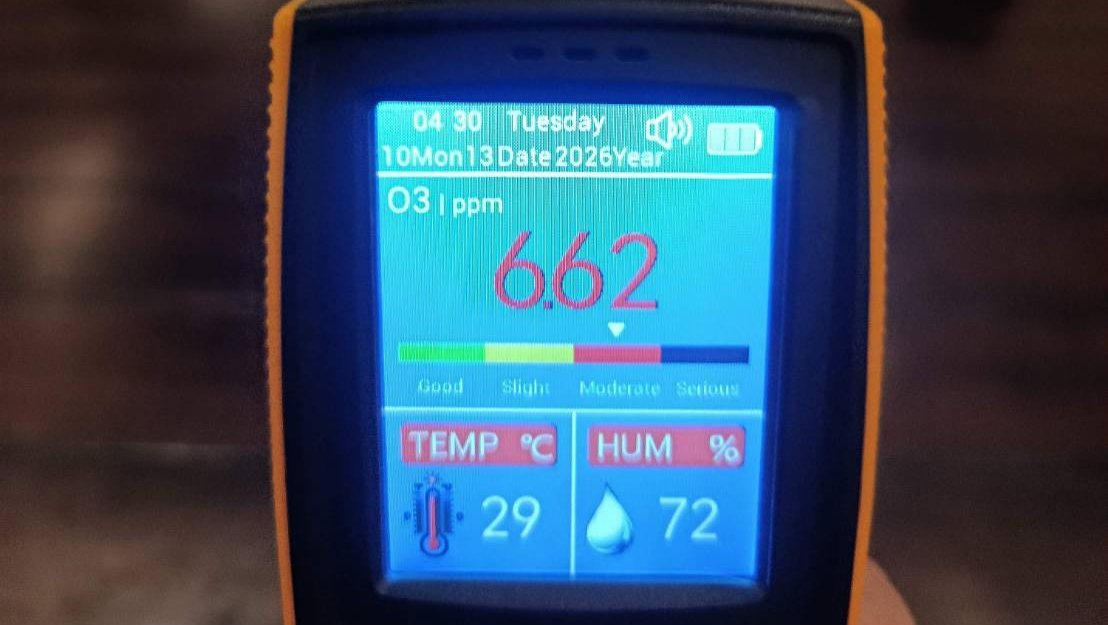
Humidity helps too: ozone reacting with water vapor forms hydroxyl radicals (OH), which break down some compounds faster than ozone alone. Our team measures ozone with a meter on every job, both during treatment and before handing the room back.
How ozone reacts with common odor compounds
The equations below show the overall result when each compound is fully oxidized. Every equation has been checked for atom balance.
| # | Compound | Found in | Reaction with ozone |
|---|---|---|---|
| 1 | Acetone | Nail polish remover, thinner | CH3COCH3 + 8O3 → 3CO2 + 3H2O + 8O2 |
| 2 | Formaldehyde | Particleboard furniture, glue, new carpet | HCHO + 2O3 → CO2 + H2O + 2O2 |
| 3 | Propylene Glycol | E-cigarette liquid, cleaning products | C3H8O2 + 8O3 → 3CO2 + 4H2O + 8O2 |
| 4 | Benzene | Cigarette smoke, vehicle exhaust | C6H6 + 15O3 → 6CO2 + 3H2O + 15O2 |
| 5 | Styrene | Foam, plastics, cigarette smoke | C6H5CHCH2 + 20O3 → 8CO2 + 4H2O + 20O2 |
| 6 | Tricresyl Phosphate | Engine oil, hydraulic oil | 2C21H21PO4 + 102O3 → 42CO2 + 21H2O + P2O5 + 102O2 |
| 7 | Toluene | Paint, thinner, glue | C6H5CH3 + 18O3 → 7CO2 + 4H2O + 18O2 |
| 8 | Xylene | Paint, varnish | C6H4(CH3)2 + 21O3 → 8CO2 + 5H2O + 21O2 |
| 9 | Butane | Lighter gas, aerosol sprays | C4H10 + 13O3 → 4CO2 + 5H2O + 13O2 |
| 10 | Propane | Cooking gas (LPG) | C3H8 + 10O3 → 3CO2 + 4H2O + 10O2 |
| 11 | Methylene Chloride | Paint stripper | CH2Cl2 + 2O3 → CO2 + 2HCl + 2O2 |
| 12 | Trichloroethylene | Metal degreaser | C2HCl3 + 4O3 → 2CO2 + HCl + Cl2 + 4O2 |
| 13 | Aminophenol | Hair dye | 2C6H7NO + 29O3 → 12CO2 + 7H2O + N2 + 29O2 |
| 14 | Ethylene | Ripening fruit, fruit stores | C2H4 + 6O3 → 2CO2 + 2H2O + 6O2 |
| 15 | Ammonia | Pet urine, bathrooms | 2NH3 + 3O3 → N2 + 3H2O + 3O2 |
| 16 | Hydrogen Cyanide | Cigarette smoke, fire smoke | 2HCN + 5O3 → 2CO2 + H2O + N2 + 5O2 |
How to read this table
These are theoretical overall reactions, and not every compound reacts at the same speed. Compounds with a double bond, such as styrene, ethylene and trichloroethylene, react with ozone quickly. Others, such as benzene, toluene, butane and propane, react slowly, which is why a high enough concentration and a long enough treatment time matter. Real results in a given room depend on concentration, time, humidity and how much of each compound has built up.
What ozone can and cannot fix
- It can: odors in the air and soaked into fabrics, mattresses, carpets, ceilings and AC ducts — cigarette smoke, mustiness, paint and glue after a renovation.
- The source must go too: if the source is still there — urine that has soaked under flooring, or a dead animal above the ceiling — ozone reduces the smell for a while, but it returns until the source is removed. Read about pet odors
- Ventilate afterwards: incomplete reactions can leave small amounts of intermediate compounds, so airing the room out after treatment is a step we never skip.
Safety: 3–5 ppm is dozens of times higher than what is safe for people in the room (the guideline for continuous exposure is no more than 0.1 ppm). No people, pets or plants may be in the room during treatment, and the room must be ventilated until the meter reads below 0.1 ppm before anyone goes back in. Read about ozone safety
See our treatment rates on the odor removal page.
Want to know whether your place can be fixed?
Talk to us first — free consultation, no obligation. If ozone is not right for your problem, we will tell you straight.
Get a free consultation